
flyjev · measured results · September 30, 2026
119 out of 121, and the two errors that remained
The fly-jev Y0-system deciding on images at 258 tokens per photo. Below is everything that was measured, including what didn't work.
The number
| group | n | short prompt | with the boundary | delta |
|---|---|---|---|---|
| 1 photo · obvious yellow | 44 | 44/44 | 44/44 | — |
| 1 photo · small yellow | 17 | 17/17 | 16/17 | −1 |
| 1 photo · no yellow | 31 | 18/31 | 30/31 | +12 |
| 1 photo · yellow's neighbors | 29 | 8/29 | 29/29 | +21 |
| total | 121 | 87/121 = 0.719 | 119/121 = 0.983 | +26.4 pts |
Same machine, same model, same photos, same time of day. The only thing that changed between the two columns was 43 tokens of prompt — the prompt p50 went from 347 to 390.
It reproduced on another machine
The same round was repeated on another machine, in another state, with a different server configuration. Out of 121 photos, 121 identical predictions, the same two errors, on the same photos. The result belongs to the system, not to the machine.
The photo's position doesn't matter
36 calls send 2, 3 or 4 photos together, with the yellow one in every position. If the model had a position bias — looking more at the first, or the last — it would show up here.
| set | n | short | with boundary |
|---|---|---|---|
| 2 photos · yellow in any position | 6 | 6/6 | 6/6 |
| 3 photos · yellow in any position | 9 | 9/9 | 9/9 |
| 4 photos · yellow in any position | 12 | 12/12 | 12/12 |
| sets with no yellow at all | 9 | 2/9 | 9/9 |
Finding the yellow was never the problem: 27 out of 27 in every position, with both prompts. The problem was finding yellow where there was none — and that is exactly where the boundary acts.
The multi-photo sets ran on different machines in the two columns. For the single photos, where there is a pair on the same machine, the two accuracies came out identical — but this specific row doesn't have that control.
Cost and time
| measure | value |
|---|---|
| calls in the full round | 157 |
| transport errors | 0 |
| input tokens, total | 47,034 |
| reported cost of the round | US$ 0.00198 |
| total time, concurrency 4 | 52 s |
| model latency, p50 / p95 | 104 / 163 ms |
| tokens per photo, any resolution | 258 |
The number of tokens per image is fixed: 258, whether the photo has 0.3 or 13 megapixels. Whoever charges by pixel area charges 45 times more for the big photo; here the bill doesn't change.
The two errors
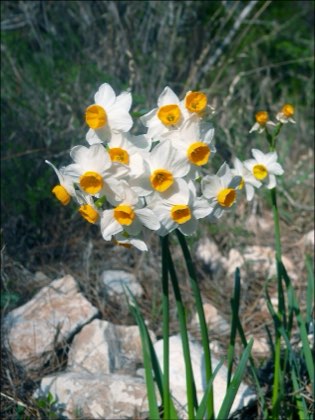
daffodil_03.jpg
Daffodil. Genuinely yellow, and the boundary took it down too: p(yes) dropped from 1.000 to 0.349.
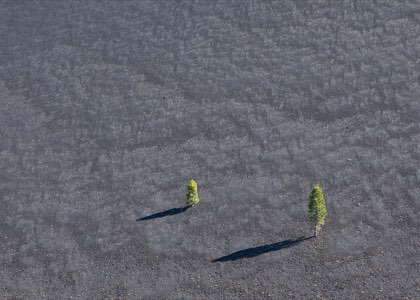
pine_tree_08.jpg
Wrong with both prompts. p(yes) 0.925 → 0.842: the boundary lowered the confidence, it didn't change the answer.
The daffodil is the declared price of the change. By tightening the definition of yellow, a small, legitimate yellow went with it. It is an error, it counts as an error, and it sits in the table above as the −1 in the small-yellow group.
What this test doesn't show. It's color, not domain: it says nothing about reading a medical report, an invoice or a defective part. And 121 photos is few — the difference between 0.983 and 0.975 here is one photo. What it shows well is the direction of the prompt's effect, which is large enough not to fit inside the noise.