
flyjev · how it works
One sentence moved 26 points. It's worth understanding why.
It wasn't the model that got better, nor the machine, nor the context. It was the wording of the request — and the effect isn't what it looks like at first sight.
What the model returns
A flyjev decision is not a piece of text we claim says "yes". It is the probability distribution over the options you declared. For a binary question, the result is a point on a ruler from 0 to 1, and the answer is the side it landed on.
That number is the product. It lets your code decide what to do with the answer — accept it, send it to a human, ask for another photo — instead of treating every answer as equal.
Where the short question fails
We asked "is there anything yellow in this image?" and declared two options. Across 121 photos, the model got every case with yellow right and missed 72% of the cases where there were only neighboring colors — tangerine, red fur, orange cat, sand dune.
The question wasn't wrong. It was incomplete: it didn't say where yellow ends and orange begins. Without that limit, the model uses its own — and its own is wider than ours.
Forty-three tokens. Accuracy from 0.719 to 0.983.
The effect is selective, not general
The easy reading would be "the sentence made the model more conservative, so it says yes less often". The numbers say something else. We measured how much the probability of "yes" shifted in each group:
| group | n | mean shift of p(yes) |
|---|---|---|
| has yellow | 44 | −0.040 |
| has yellow, small in the scene | 17 | −0.054 |
| no yellow | 31 | −0.285 |
| no yellow, neighboring colors | 29 | −0.488 |
The sentence moves the probability twelve times more where there was ambiguity than where there wasn't. It didn't push everything down — it resolved a doubt that only existed in certain cases.
That's why accuracy on the positives barely changes while accuracy on the hard negatives jumps. The missing information was only needed where the scene sat close to the border.
Three cases, side by side
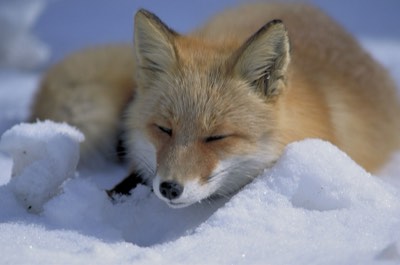
Red fox
−0.775 · crossed the threshold
Ambiguous by definition: fur between orange and yellow. The sentence resolved the doubt, and the decision flipped with it.

Yellow umbrella
−0.018 · practically still
There was no doubt to resolve. The same sentence that dropped the fox by 0.78 moved 0.02 here.

Small daffodil in the scene
−0.651 · crossed to the wrong side
The cost. The word "clearly" was read as a demand for prominence, not just hue — and the only positive lost out of 121 was this one.
Every sentence cuts both ways
The same instruction that fixed 33 cases broke 1. Had we written only "orange is not yellow", without the "clearly", we would probably have kept the 33 without losing the daffodil — but that is a hypothesis, not a measurement. What is measured is that the prompt is a lever with two directions, and that it needs to be tested on a labeled set, not chosen by intuition.
How to tell whether your question is incomplete
The pattern we found here isn't about color. It shows up whenever the decision depends on a rule that lives in the asker's head and not in the text of the question. Three signs:
- The errors have one sign only. If almost all are false positives or almost all are false negatives, it isn't noise — it's a threshold in the wrong place.
- The errors cluster by subject. Five tangerines, six foxes, three orange cats. When the error list has a theme, the theme is the missing definition.
- Confidence stays high when it's wrong. An error at 0.93 isn't model uncertainty. It's the model confidently answering a different question from yours.
That's why we measure the question, not just the model
Switching machines, enlarging the context or changing the server configuration added less than 2 points in our tests. Completing the prompt added 26. A diagnosis that looks at the distribution of errors — sign, clustering and confidence — finds this without anyone reviewing case by case, and that is what we are turning into a tool.